Wednesday, August 5, 2026

Another Stab at a "Five-tool" Number

 By John Turney 
In baseball scouting, few labels carry more weight than "five-tool player." It describes the rare athlete who can hit for average, hit for power, run the bases with speed, field with range and sure hands, and throw with strength and accuracy. The term has become shorthand for the complete player—the one who impacts the game in every phase.

Willie Mays stands as the archetype. 

Across 22 major-league seasons, he posted a .302 major-league career average, 660 home runs, 338 stolen bases, 12 consecutive Gold Gloves, and a fine arm that regularly cut down runners. He did it with flair—basket catches, hat flying off as he raced around the bases—and with a consistency that made the extraordinary look routine. Contemporaries and later generations alike have pointed to him as the standard against which all other five-tool candidates are measured.

The concept itself predates the modern phrase. 

Branch Rickey, the innovative executive who built the Cardinals' farm system and later integrated the majors with Jackie Robinson, emphasized five core "talents" or tools when evaluating players. He reportedly considered only two true five-tool stars of his era: Mays and Mickey Mantle. Scouts working under Rickey’s influence, including Al Campanis, formalized grading systems that scored prospects on those same categories—hitting, power, speed, arm, and fielding.

Campanis, a longtime Dodgers scout and later general manager, used exactly that framework. In one widely reported evaluation of major-league talent, the Dodgers' scouting staff (working under Campanis) assigned point values to those five skills. Mays was the only player judged perfect in every category. Campanis reportedly told a reporter the Dodgers would have paid $1 million for him on the spot—big money at the time—because no one else matched that complete profile.

Leo Durocher, Mays's manager with the New York Giants, gave the idea its most memorable public expression. 'There are only five things you can do in baseball," Durocher said: hit, hit with power, run, throw, and field. "Mays had it all." He later added that Mays also possessed the intangible that turned a superstar into something rarer: the ability to light up a room and lift an entire clubhouse.

The phrase 'five-tool player' did not become common in print until later decades, but the underlying idea—looking for the complete package rather than a one-dimensional specialist—took firm root in the 1950s with Mays as its living example. Whether traced through Rickey’s scouting philosophy, Campanis’s formal grading, or Durocher’s blunt praise, the label found its perfect illustration in the Say Hey Kid.

True five-tool players remain scarce. Most big-leaguers excel in two or three areas. Mays excelled in all five for the better part of two decades, and in doing so gave baseball a permanent measuring stick.

So how do we measure the five tools? Here is one proposal: Do it like Bill James' Power-Speed number. He took home runs and stolen bases and did a harmonic mean calculation. It's better than averaging the two because one has to do well in both categories, i.e., power AND speed.

This is our second attempt at doing something similar. We picked five metrics that measure hitting (on base percentage, which includes hits and walks), Isolated power for "hitting with power," and then metrics that purportedly measure base running, fielding and throwing. We do a harmonic mean on them and let the chips fall where they may.

Five-Tool Ranking Method
To identify true five-tool players, we selected five statistics that roughly correspond to the classic tools: on-base percentage (hitting for average/getting on base), isolated power (hitting for power), base running, fielding, and throwing.

These values were adjusted so they could be combined with a harmonic mean, following the approach Bill James used for his Power-Speed number. The harmonic mean rewards balance heavily—players must perform well across all categories to score highly. Dominating one area while being weak in others produces a much lower result.

Minimum thresholds
On-base percentage: .375 or higher
Isolated power: .200 or higher
Rbase had to be a career total of 20
Rfield had to be at least 20 (Ken Griffey added as example)
Rof/Rthrow had to be positive. 
Players who fall short of these marks are excluded.

Adjustments applied
OBP and ISO are multiplied by 100 (so a .300 OBP becomes 30).
Fielding: Career fielding runs (Rfield) but would like to comine it with Defensive Regression Analysis (DRA) and average them (each would be divided by two and then combined, then divided by 10). Because neither metric is clearly superior, equal weight is given to both. But we cannot get our hands on recent DRA totals. So we went with Rfield.

Base running: Baseball-Reference’s "Rbaser – DP" (base-running runs minus double-play avoidance) is divided by two. For example, Willie Mays’ career total of 70 becomes 35 in the calculation.

Throwing/arm value: Career outfield arm runs (Rof) for outfielders, or the equivalent throwing runs for the two infielders who cleared the thresholds, are also divided by two. Barry Bonds’ career total of 36 Rof, for instance, appears as 18.

Only players who clear the OBP and ISO and other floors and then post solid adjusted scores in the remaining three categories remain. The resulting list is short—true five-tool performers across a full career are rare.

Issue: for some infielders there was no "Rthrow" when they played so the throwing aspect was ignored and it is a 4-tool number. However, don't fret; the way harmonic means work is one has to do well in everything, so even if all those players were given a score of say, 99, it wouldn't put them atop the list. In fact it wouldn't get any of them to 20. So we did the best we could.

It is notable that only 20 players even qualified; Ken Griffey really didn't, but we included him to show what one very low number can do to a harmonic mean. 

The chart:

It is no surprise that Willie Mays is number one. His career on-base percentage was .384, his isolated power was .255. His Rbaser+DP was 70. His Rof is 55 (with a slight adjustment for 1951 and 1952 since that stat began in 1953). We added five runs saved, which may be low. But even if we went with the official total of 50, it makes very little difference. 

His DRA was 195, and his Rfield is 185, so the average of the two was 190. 

All that means is his Five Tool number is over 27. Only Barry Bonds is close. 

Last time we used different numbers and since we used outfield assists, more players were included who don't have at least a ten in DRA/Rfield, but the top two people were the same. Ricky Henderson didn't make it this time because is Rof was negative. 

Someone else, we are sure, could do a better job on this. It would be helpful of Baseball Reference added Rthrow and Rof to their search engine (Stathead) so others can follow what we've done and improve it. Surely many would be better. But this is a start. 

Thoughts?

Stuff You Cannot Lay Your Hands On: Rof, Total Zone Outfield Arm Above Average

 By John Turney 
Part of Baseball Reference's "Rtot" number (which is defined on the site as "Total Zone Total Fielding Runs Above Avg: The number of runs above or below average the player was worth based on the number of plays made. This number combines the Rtz, Rdp, Rof, Rcatch numbers into a total defensive contribution." Provided by BaseballProjection.com) is the "Rof" number.

Rof is "The number of runs above or below average the player was worth based on baserunner kills and baserunner advances."

It purports to give an estimation of effective arms in MLB. How good is it? I don't know. Mike Walsh, an excellent researcher by all accounts, also has a similar number, which is usually a lower total. Beats me, but at least we can find Rof on Baseball Reference.

The problem is Rtot and Rof, and others is they are not part of the search engine options, so we cannot easily find who the career leaders. Some pages show the yearly leaders, and that is what we used to ge the following list. 

One note, this was done my a lot of cutting and pasting and the credit goes to Baseball Projection and Baseball Reference, but there may be an error or two, but things were double-checked. Also note that there are active players listed and their totals are changing.

So here it is:
There is nothing earth-shattering; Roberto Clemente is on top, as would be expected but it's nice to see some modern players on it as well. The metric goes back to 1953, so players before that are out of luck. 

Note that this is not just outfield assists, it is holding runners and also throwing them out or "kills" so while you can find a list of assists on Baseball Reference, you have to hand sort them to analyze only outfielders. 

Take a look, see what you can make out of it, and hopefully, someday Baseball Reference will add this and other metrics to their search engine "Stathead" and then it can be messed around with by minds greater than ours and applied in new ways. 

Wednesday, July 6, 2022

PITCHING: The Chicago Cubs 2022

 By TJ Troup

The Cubs are playing the Brewers as I write this. The Cubs have reached the halfway point with a record of 33-48; which, of course, translates to a season of 96 losses. The team e.r.a. is 4.70, which is NOT the worst in my lifetime of following the Cubs (1959-2022). 

Last year's team E.R.A. was the worst at 4.87 but will go to my grave knowing that the staff in '62 was pathetic with a team E.R.A of 4.54. That team with the disastrous "college of coaches" sent men to the mound without a clue how to pitch, or did not have the stuff to get opposing hitters out. Since there were two expansion teams in the National League and both the Colt 45's and Mets did not have a strong hitting line-up...yet Cub pitchers struggled to get them out also. 

Have many fond memories of going to both Wrigley & Dodger Stadiums and seeing Cub pitchers succeed. Ellsworth in '63, Holtzman, Jenkins, Maddux, Arrieta, and no one on this current staff is good enough to carry their glove to the mound. Just damn sad. 

Friday night late here in Kentucky the Cubs travel to Dodger Stadiums, and MLB will televise the game and will have my Smokehouse Almonds and Dr. Pepper's ready. 

Will close this short story by getting on my political soapbox. Ready? Recently read a poll that stated that only 28% of Americans are proud of this Country. On those days I take the field in the 70+ softball leagues and see my peers play a game we love with joy you can feel that pride. We are a proud group of men that believe in the red, white, and blue.

Friday, June 10, 2022

SMOKY BURGESS

By TJ Troup 

There have been many men who lacked the ability to run, yet could swing the bat, and hit, and hit well. This is the saga of one of those men. Smoky Burgess began his major league career with the Cubs and after a couple seasons was traded to Philadelphia. 

His season of 1954 ranks as one of the best ever for a catcher swinging the bat. By the end of April he was hitting .364, and on May 31st he hit a pinch-hit home run over the Dodgers to up his average to .366. Sixty-eight years ago today was one of the signature days of his career. He singled home Hamner in the second, doubled home Hamner in the fourth, got a single to advance Hamner in the fifth, and was walked in the seventh. 

The Phillies beat the Cubs that day 4-0, and Smoky was now hitting .392. When was the last time you remember a catcher hitting .392 in early June?

 Burgess earned his first All-Star berth that year, and finished the year hitting .368! He did not qualify for the batting title since he did not have the required number of plate appearances. Though he was playing well for the Phillies in early '55 he was traded to Cincinnati, and he again had an outstanding season and earned another all-star berth. 

There have been many baseball trades that were a key aspect for a team turning the proverbial "corner" and truly becoming a contender. Pittsburgh had some awful seasons in the early to mid '50's yet when Burgess was traded to the Pirates before the '59 season (3rd baseman Don Hoak was also a key figure in the trade)...Pittsburgh played strong baseball, though they finished 4th. 

On Sunday August 30th the Pirates swept a doubleheader from Philadelphia and were only four games out. The Friday and Saturday games that preceded the sweep Burgess was 7 of 10 with 3 home runs, and 5 rbi's in the two victories. Smoky hit .297 in '59, and when Sports Illustrated issued their sixth annual baseball edition on April 11th the writers---especially Roy Terrell stated the following. "They  (meaning of course the Pirates) are probably too good to be passed by the Reds, Cubs, Cardinals, or Phils. But though they may improve enough to pass one of the three leaders, should the Dodgers or Braves or Giants slip, it is hard to see them passing all three". Ooops Roy, they did pass all three, and beat a strong Yankee team in a classic World Series. Smoky continued to hit consistently and finished with a .294 average.  

Terrell also stated "Burgess as always was hitting". Was able to see Smoky play against the Cubs when the Pirates visited Wrigley since all Cub home games were televised. Though he was not as strong a defensive catcher as he was early in his career, he sure was damn impressive with his long-barreled bat in his hands. Listed at 5'8"" he stood erect in the batter's box, and kept his hands up which made his bat look even longer. 

When the opportunity arose and got a chance to go to Wrigley those were days that I cherished; and on Sunday June 23rd the family was in the "friendly confines" and was able to meet my hero Ernie Banks face to face that day before the game. Since the Cubs were playing the Pirates got to see Smoky get a hit that day in person. The National League had many outstanding all-star teams in the '50s & '60s and one of those was the '64 group that won at Shea Stadium. 

Though Smoky did not play that day, he did earn his final all-star berth. Every team looks to add young talent to the line-up, and as such Burgess was traded to the White Sox. The Pale Hose were in a three team pennant race with the powerful Yankees, and the improved Orioles. 

On September 15th in Detroit Joel Horlen has pitched a masterpiece but trails 2-1 in the top of the 8th, and in his first American League at-bat pinch-hitting for Horlen...Mr. Burgess ties the game as he belts a long home run. 

Yes folks, the White Sox went on to win in extra innings. Burgess was called upon to pinch-hit many times in 1965 & 1966 and if you go to Baseball-Reference you will come to realize he was one of the best pinch hitters in baseball history for his exploits in those two seasons. Burgess final year was 1967. 

Tuesday, April 12, 2022

1965 AL and NL Gold Glove Winners with Second-teams

By JT  
Bob Gibson
Nineteen Sixty-five was the last year The Sporting News published vote totals for the Gold Glove awards, thus ending our series.

Here is the 1965 edition
American League
First-teams left, Second-teams right 

National League
First-teams left, Second-teams right 

National League team only listed two outfielders behind the three award-winners. 

1964 AL and NL Gold Glove Winners with Second-teams

 By JT 
Ron Santo
In 1964 the Sporting News was still publishing votes for their Gold Glove polls and thus Second-teams could be compiled. Here are the 1964 results:
American League
First-teams left, Second-teams right

National League
First-teams left, Second-teams right 

1963 AL and NL Gold Glove Winners with Second-teams

 By JT 
Al Kaline
This is the 1963 iteration of The Sporting News Gold Glove Awards with complete Second-teams—
The American League:  
First-team left, Second-team right

The National League:  
First-team left, Second-team right


1962 AL and NL Gold Glove Winners with Second-teams

 By JT  
Ken Hubbs
Here are 1962's Gold Glove Winners and runners up as chosen by The Sporting News—
American League:  
First-team left, Second-team right


National League:
First-team left, Second-team right
Source: The Sporting News, 11/10 and 11/17, 1962

1961 AL and NL Gold Glove Winners with Second-teams


I like to give credit where credit is due and when it comes to Gold Gloves that is including the Second-teams or runners-up that were awarded when The Sporting News handed out the winners of the Glove Gloves

Here are the winners and those who followed them in the voting for 1961—
American League:
First-team left, Second-team right
National League:
First-team left, Second-team right
Note: Only one outfielder was named to the NL Second-team

Tuesday, March 15, 2022

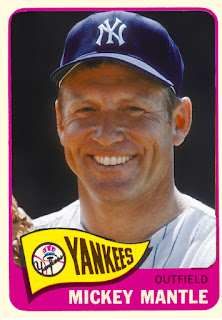
Mickey Mantle Awards Roll Call

 by JT 
Mickey Mantle's career honors and awards—

1974—Baseball Hall of Fame
1956—Associated Press Athlete of the Year Award
1956—Most Valuable Player Award (BBWAA)
1956—Sporting News Major League Player of the Year Award
1956—Sporting News Player of the Year Award
1956—Silver Bat Award (Bud Hillerich Award)
1957—Most Valuable Player Award (BBWAA)
1962—Gold Glove Award (American League Outfielder)
1962—Most Valuable Player Award (BBWAA)
1962—Sporting News Player of the Year Award


All-Star selections
1951—All-Rookie (TSN)
1952All-MLB (TSN); All-AL (UPI); MLB All-Star
1953MLB All-Star
1954Second-team All-MLB (AP); MLB All-Star
1955All-AL (UPI); Second-team All-MLB (AP); MLB All-Star
1956All-MLB (AP, TSN); All-AL (UPI); MLB All-Star
1957All-MLB (AP, TSN); All-AL (UPI); MLB All-Star
1958—All-MLB (AP); All-AL (UPI); MLB All-Star
1959Second-team All-AL (UPI); MLB All-Star
1960Second-team All-MLB (TSN); All-AL (UPI); MLB All-Star
1961—All-MLB (AP, TSN); All-AL (UPI); MLB All-Star
1962—Second-team All-MLB (AP); All-AL (TSN); MLB All-Star
1963—MLB All-Star
1964—All-MLB (AP, UPI); All-AL (TSN); MLB All-Star
1965—MLB All-Star
1966
1967MLB All-Star
1968MLB All-Star

Post-season honors: Mantle was an All-MLB pick six times, Second-team four times and All-American League nine times, and Second-team All-AL once. Note: 1954 there were no All-AL or All-NL teams.

In summary, Mantle got post-season honors in 11 of his 18 seasons, not counting the mid-season All-Star selections. 

Saturday, February 26, 2022

1975 WAR and All-Star Teams

 By JT 

As part of the series here are the WAR All-Star teams


Here are the UPI All-AL and All-NL squads—


And the TSN All-AL and All-NL—


And the AP All-MLB Team—

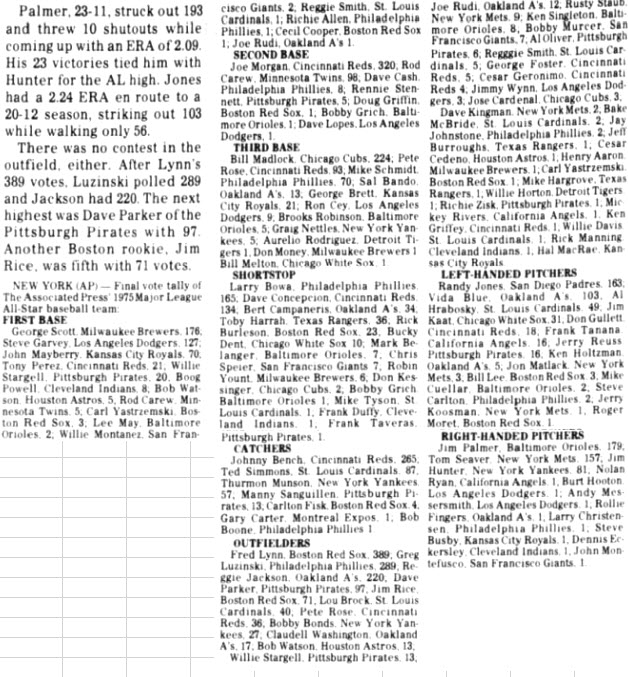
And finally the All-Star Team Rosters—


Tuesday, February 22, 2022

Joe Rudi's 11-year Peak

 By JT  

Joe Rudi had a very nice mini-peak from 1974-75 hitting .285 and per 162 games 21 HRs and 97 RBI while playing excellent left-field winning three Gold Gloves—
But his long "peak" was eleven years and he still averaged those 93 RBO but his power and average were down.


So, we salute Joe Dirt, errr  . . Joe Rudi

1972—MLB AL All-Star; ALl-MLB Second-team (AP, NEA); All-AL (TSN)
1974—MLB AL All-Star; All-AL  (TSN, UPI); Gold Glove
1975—MLB AL All-Star; Gold Glove
1976—AL TSN All-Star; Gold Glove

Thursday, February 17, 2022

Nate Colbert's Peak—1969-74

 By JT  
Nate Colbert had a high, short peak after joining the Padres. With them, per 162 games, he hit .253 averaged 30 dingers and 90 RBI.

After leaving playing for any other team he hit less that the Mendoza line—
(click to enlarge)
Nate Colbert's Stats per PFR