Monday, February 14, 2022

Bobby Bonds—A Near Great

 By JT 
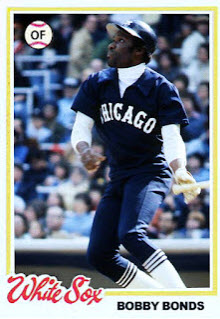
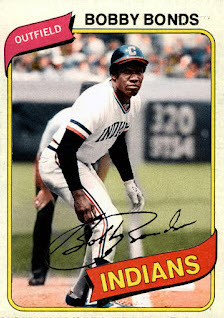
Always loved Bobby Bonds and his power and speed and arm and the rest of his skill set. Even so, looking back, we are not sure we can call him great. 

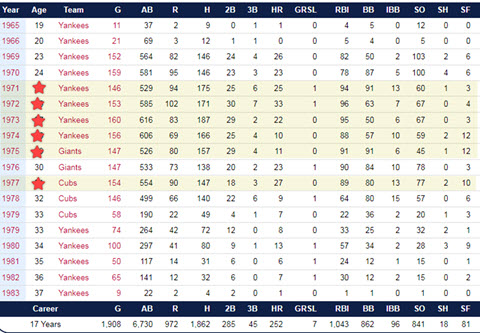
His 11-year peak (shown above, courtesy PFR) shows a guy who averaged 28 HRs and 39 SBs over that span. He was a good right fielder with a very, very good arm. 

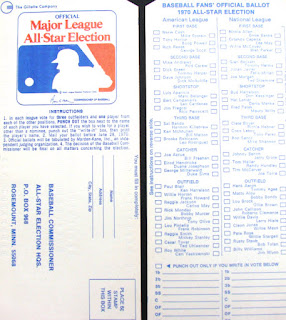
He received MVP votes in 1969, 1971, 1973, 1975, and 1977 and was an All-Star in 1971, 1973, and 1975 and was a Sporting News All-Star in 1973 and 1977 (UPI and AP also) and an honorable mention in 1978 by UPI.

He was All-MLB in 1973 (NEA) and also Second-team All-MLB by AP. He was an honorable mention All-MLB pick in 1975.

In summary Bonds post-season honor years (Votes for MVP and/or All-Star teams)—
1969, 1971, 1973, 1975, 1977, and 1978.
He also won three Gold Gloves (1971, 1973, 1974).

Amazingly he had nine titles in "Power-Speed"—

All we know is he'd be great in today's game.


Saturday, February 12, 2022

Ken Henderson—Darned Good

By JT


 Playing next to Willie Mays had to help in the field, but Ken Henderson played some solid ball but when Gary Matthews came to the bigs, Henderson was expendable and traded to the white Sox

He played for seven teams in his career and had a nice 7-year peak from 1970-76—


Henderson had some pop in his bat (average 17 HRs per 162 games) and some speed (13 SBs in the same span) and averaged 30 doubles as well. He was a fine left fielder and a decent arm (15 assists in 1970 and 14 in 1972).  
While no superstar he was a solid player and in 1974 he was 19th in MVP voting and was likely the best centerfielder in the Al that year, ranking fourth in WAR and leading in OPS, SLG, doubles, HRs and RBI—
Had the UPI picked position players, rather than just three outfielders he'd have likely been All-AL that year. 

One of our favorite stats is the Power/Speed number—

He was in his league's top 10 for times—
1970 NL  18.4 (6th)
1971 NL  16.4 (5th)
1972 NL  15.8 (10th)
1974 AL  15.0 (6th)
(source Baseball Reference)

So, here's to Ken Henderson, a good compliment to a star centerfielder and for one year (1974) a fine near-star player in centerfield.

Sunday, February 6, 2022

Al Oliver—A Fifteen-year "Peak"

 By JT 
Al Oliver was one of my favs. Looking back it seems even I have underrated him. Here is his 15_year "peak" his top consecutive seasons. It spans for 15 years,s quite a long span—

From 1969 through 1983 only Pete Rose and Rod Carew had more hits.

So, in addition to having the third-most hits in MLB during his 1969-83 peak, Al Oliver played the second-most games, the second-most doubles (behind Rose) the fifth most triples, was fourth in runs driven in, hit .305 (good for seventh among those with 5,000 at-bats), and was 13th in fewest strikeout percentage and six of those ahead of him were middle-infielder singles hitters types. In addition, he hit 215 dingers. 

Also, from 1969-83 he was one of two players to have 2,000 hits, 1,000 RBI, steal 80 bases, have 40 triples, and 200 home runs showing power and some reasonable speed and power . . . the other? Bobby Murcer.  

Oliver was consistent in "blue shade" 12 of 18 seasons. Blue shade is seasons getting some sport of post-season honor, silver slugger, All-star game, what have you—

In 1969 Oliver was second in the Rookie of the Year race. 
1972—All-Star
1975—All-Star
1976—All-Star and Second-team All-NL (UPI)
1978—All-AL (AP and UPI)
1980—All-Star
1981—All-Star and Second-team All-AL (UPI)
1982—All-Star, Second-team All-MLB (AP), and First-team All-NL (TSN and UPI)
1983—All-Star


Saturday, January 29, 2022

Bobby Murcer's All-Star Selections—1971-75, 1977

 By JT 
Bobby Murcer was always a favorite. He had a ton of pressure on him to be the "next Mickey Mantle" which he wasn't. he did not have Mantle's natural speed and ability and that showed up in his stats, fewer home runs and fewer stolen bases, lower almost everything.

However, Murcer was a fine ballplayer who could hit, hit for average, run, steal, field, and throw. He played 17 seasons and played the majority of his career for the New York Yankees. He was a one-time Gold Glove winner and five-time All-Star and was voted to the AP' American League 1970s All-Decade team. Murcer led the American League in on-base percentage in 1971, and in runs and total bases in 1972.

In this post, we will review his All-Star picks, both the All-Star games and the AP, UPI, NEA, and TSN picks.

The years he got post-season honors were 1971-75, and 1977. 
1971—All-Star (MLB-AL,  AP-2nd team All-MLB, NEA-2nd team All-MLB, TSN-All-AL)

1972—All-Star (MLB-AL,  AP-2nd team All-MLB, NEA, 2nd team All-MLB, TSN-All-AL)

1973—All-Star (MLB-AL,  AP-2nd team All-MLB, NEA-2nd team All-MLB, TSN-All-AL)

1974—All-Star (MLB-AL)

1975—All-Star (MLB-NL, UPI All-NL-2nd team, AP-honorable mention)

1977—All-Star (UPI All-NL-2nd team)

Key: MLB = Major league All-Star Game; AP = Associated Press; TSN = The Sporting News; UPI = United Press International; NEA = Newspaper Enterprise Association

Source: Newspapers.com


Friday, January 28, 2022

Bobby Murcer vs HOF Pitchers

 By JT  

Bobby Murcer couldn't live up to being the "next Mickey Mantle", but who could? Murcer was a fine ballplayer who Bob Costas said had a "worthy career". Agreed.

What is a nice little nugget is that Murcer actually hit better versus Hall of Fame pitchers than he did on his versus his career averages—
He had a higher average, better on-base and slugging percentages, more home runs facing the tougher pitchers. 

He had trouble with Gaylord Perry, whom he had a rivalry with over spitballs, and with Phil Niekro who had a fierce knuckleball about whom Murcer once said, "Trying to hit Phil Niekro is like trying to eat jello with chopsticks". 

Note:  when Jim Kaat and Tommy John—two pitchers that are near 300 wins, his at-bats go to 640, his batting average rises to .292 and his home run total goes to 24 and his RBI total jumps to 85.

Certainly, it can be said Murcer hit well against the best. 

Well done, Kid. 

Thursday, January 27, 2022

Willie Mays Was Unfairly Caricatured in 1972 and 1973

 By JT  
Mays was streaky, especially late in his career. And the truth is he slumped badly early and late in 1972 and 1973. But as a role player, check out mid-season numbers, especially 1972. He was not the "Willie Mays" everyone had grown to know from 1951-71 but he was not the caricature some make him out to be with Mets—Too old to play, cannot field anymore. Those, in our view, were exaggerated to a large degree.

The Mets got the World Series in 1973 based on a elite pitching and fielding. Their offensive punch was lacking and Mays was a net asset which maybe you will agree with when you finish the post. 
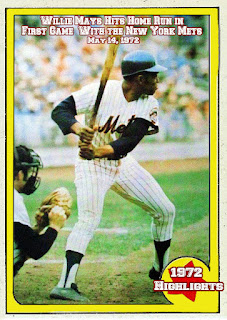
In 1972 when he arrived he hit a homer in his first game and from that day through August 20 he hit .288 with 8 home runs.
The next year he again slumped early then on April 28, again in spot duty, hit .249 with six home runs through August 24th.


Of course, his seasons' totals were not as good because of the aforementioned early- and late-season slumps.
But consider in 1973, for example, during that April 28 to August 24 period, here is what the Mets heavy hitters did.

John Milner, the power hitter hit .234 with 16 HR and a .746 OPS (Mays' was .743)


Staub hit .286 but his OPS was .785 and he hit 8 home runs over 220 more at-bats. 

The Mets regular centerfielder was Don Hahn. He was hurt early in the season and came aboard in June and hit .238 but with no power. From June 16 through June 23th had a .409 average, accounting for nine of his 40 hits in this mid-season span we are examining. 


Here are the Mets centerfielders for 1973—

Left fielder Cleon Jones during this span—

Third baseman Wayne Garrett had some pop in his bat hitting 9 homers in this span, three more than Mays but a lot more at-bats, and his slugging and OPS were both below .350.

In 1973 Ed Kranepool played first base and some left field. he was usually good for 9-10, 13 more homers a season. But in 1973 he began a period where he had a decent average but his power dried up hitting .288 from 1973-75 but average only three dingers a season. Then, in 1976, his power picked back up to its pre-1973 levels. Odd.


So, when Mays had hit good stretch in the middle of the season his stats were not great. However, on that team, they were helpful to a team that was built on dominant pitching (Seaver, Koosman, Matlack, and McGraw) and excellent fielding. 

Here is the team stats for the 108-game span we are discussing—

The team hit .249 had a slugging percentage of .339. 

The year before it was similar. 
From May 14, 1972 through August 20, 1972—
Tommy Agee hit .233 with 7 HR and 25 RBI and his OPB was .332 and .384 was his slugging and he had a .716 OPS.
John Milner hit .248 and 10 HR with 25 RBI and a .347 OBP and a .439 slugging and a .786 OPS.
Cleon Jones hit .232 and his .301-.320-.621 were is OBP-SLG-OPS
Again, Mays .288 8 HR  19 RBI and a .434 OBP, and .497 SLG and a fine .931 OPS.

As for the errors in the field in the 1973 World Series, they happened. And they happened to others as well. 
Cleon Jones lost one in the Sun

Joe Rudi lost one in the Sun

And Willie had his well-documented troubles as well—


And he has his success as well, getting the game-winning hit in Game-2—

He had also got a short chopper that broke open Game 5 of the NLCS and sent the 82-80 Mets to the World Series 
So while we are cherry-picking his midseasons of 1972 and 1973 and downplaying his early season and late season slumps (he was 41 and 42 years old) we just don't think it is fair that his error and losing a ball in the sun when other players did it is reasonable, this is to say, to blame it on his staying in the game too long. Maybe he did, but that was no proof of it. 
Yes, you could say 1972 and 1973 were not productive. We buy that. They were two seasons of good production in the middle of the year as well, as good as or better than most players on his team. So let's just remember that.